
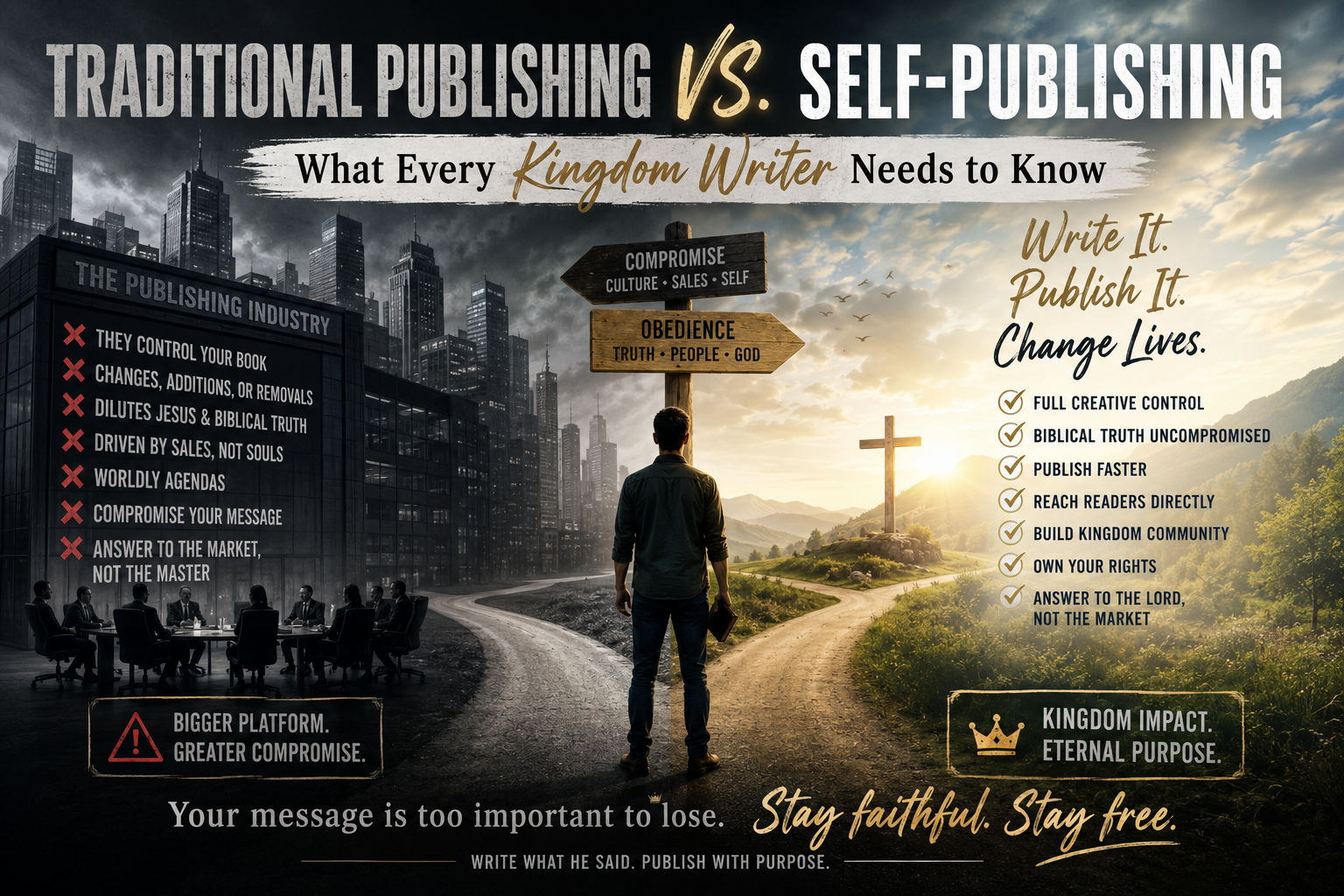
Traditional Publishing vs. Self-Publishing
Traditional Publishing vs. Self-Publishing, What Every Kingdom Writer Needs to Know
For years, traditional publishing has been presented as the “dream.”
Get the agent. Land the contract. Sign with the major publisher. Finally become a “real” author.
But Kingdom Writers need to stop and ask an important question:
Whose Kingdom are we building?
The publishing industry is not neutral. It is a business system driven primarily by marketability, trends, platform influence, and profit margins. That does not mean every person inside the industry is evil, nor does it mean God cannot use traditional publishing. He absolutely can. But many Christian creatives walk into the process unaware of what they are actually stepping into.
What Every Kingdom Writer Needs to Know
For years, traditional publishing has been presented as the “dream.”
Get the agent. Land the contract. Sign with the major publisher. Finally become a “real” author.
But Kingdom Writers need to stop and ask an important question:
Whose Kingdom are we building?
The publishing industry is not neutral. It is a business system driven primarily by marketability, trends, platform influence, and profit margins. That does not mean every person inside the industry is evil, nor does it mean God cannot use traditional publishing. He absolutely can. But many Christian creatives walk into the process unaware of what they are actually stepping into.
Traditional Publishing Often Comes With Conditions
When you sign with a traditional publisher, you are not simply handing over a manuscript. In many cases, you are handing over creative authority.
Editors may request:
Character changes
Storyline rewrites
Removal of spiritual themes
Softer language about Jesus
Broader messaging to “reach more people”
Inclusion of worldly perspectives to increase sales appeal
Agenda-driven content additions
Removal of controversial biblical truth
Why?
Because the system is usually driven by what sells, not necessarily what transforms.
A publisher’s primary goal is often market expansion. They are looking at demographics, trends, algorithms, shelf placement, public reception, and financial return. Kingdom impact is rarely the highest priority in secular publishing environments.
That creates tension for Spirit-led writers.
The very message God entrusted to you can slowly become filtered through the opinions of people who do not share your convictions.
Dilution Happens Gradually
Most compromise does not begin with outright denial of Jesus.
It begins subtly.
“Could you tone this down?”
“Can we make this less direct?”
“We don’t want to alienate readers.”
“Can we make the spiritual content more symbolic?”
“Can we broaden the message beyond Christianity?”
Before long, the fire that God breathed into the book starts cooling under corporate pressure.
What began as obedience can slowly become branding.
Kingdom Writers must recognize this clearly:
The world does not mind spirituality. The world resists the Lordship of Jesus Christ.
There is a difference.
Self-Publishing Has Changed Everything
Years ago, self-publishing carried a stigma. People viewed it as inferior or unprofessional.
That is no longer true.
Today, self-publishing allows authors to:
Maintain full creative control
Keep biblical truth uncompromised
Publish faster
Reach readers directly
Build authentic Kingdom communities
Own their rights and intellectual property
Release Spirit-led content without corporate filtering
Most importantly, self-publishing allows you to stay obedient to the assignment God gave you.
You answer to the Lord first, not a marketing department.
Bigger Is Not Always Better
Many writers secretly believe:
“If I could just get a traditional deal, then I’ll finally have influence.”
But influence in the Kingdom has never depended on worldly systems.
Jesus changed the world with fishermen, tax collectors, and ordinary people filled with the Holy Spirit.
Some of the most impactful Kingdom books will never appear on mainstream bestseller lists. Yet they will heal hearts, awaken purpose, disciple believers, and lead people to Christ.
Heaven measures success differently.
Stewardship Still Matters
This does not mean self-publishing should be sloppy.
Kingdom Writers should still pursue:
Excellent editing
Strong cover design
Professional formatting
Wise marketing
Quality storytelling
Integrity in presentation
Excellence honors God.
But excellence does not require compromise.
You can create high-quality books while remaining fully surrendered to the voice of the Holy Spirit.
Not Every Traditional Publisher Is the Same
It is important to remain balanced.
There are Christian publishers and individuals within the industry who genuinely love Jesus and desire to release powerful Kingdom messages. God can absolutely open those doors.
But wisdom is necessary.
Do not become so desperate for validation that you surrender the assignment.
Never trade obedience for opportunity.
The Real Question
At the end of the day, the question is not:
“Which path makes me more famous?”
The real question is:
Which path allows me to remain faithful to what God said?
Kingdom Writers are not merely creating products.
We are carrying messages.
We are stewarding truth.
We are preparing the way through creativity.
And sometimes protecting the message matters more than expanding the platform.
“For am I now seeking the approval of man, or of God? Or am I trying to please man? If I were still trying to please man, I would not be a servant of Christ.”
Galatians 1:10 ESV
Spiritual Branding Tricks
Spiritual branding tricks are ways of using spiritual language, symbols, and behaviors to build credibility, influence, or visibility, without submitting to the substance those things demand. They are not always intentional or malicious. Most of the time, they are learned, absorbed, and normalized.
Here are the core ones, clearly named.
1. Using spiritual language to bypass obedience
Talking deeply about God replaces actually listening to Him. Words like calling, season, anointing, assignment, warfare, or favor are used to explain why something must be done, instead of asking whether it should be done. Revelation becomes a justification, not a summons.
2. Borrowing sacred symbols to add weight
Crosses, Bibles, prayer posture, worship aesthetics, soft lighting, fog, prophetic tone. None of these are wrong, but when they are used to create atmosphere without accountability, they become props. The look feels holy even if the root is hollow.
3. Testimony as leverage
Sharing pain, deliverance, or past darkness in ways that subtly position the storyteller as the hero. The story becomes a brand asset. The more shocking the past, the more authority the present is assumed to have. The cross becomes a backdrop instead of the center.
4. Urgency manufactured by God-talk
Phrases like God told me now, this is a divine moment, don’t miss what God is doing, are used to pressure response. True urgency from God produces peace and clarity. Manufactured urgency produces anxiety and compliance.
5. Platform baptized as calling
Growth, reach, followers, sales, and influence are interpreted as proof of divine approval. Fruit is measured by scale instead of faithfulness. When numbers dip, panic sets in, not prayer.
6. Depth without submission
Sounding prophetic without being accountable. Teaching revelation without relationship. Correcting others while remaining uncorrectable. Spiritual authority is projected through tone instead of tested through fruit.
7. Vulnerability curated for effect
Sharing struggles just enough to seem authentic, but not enough to risk change. Confession becomes content. Transparency is managed so it strengthens trust without costing control.
8. “Jesus in the content” without Jesus in control
Jesus is mentioned often, quoted well, referenced sincerely, but never allowed to interrupt direction, timing, or ambition. He becomes the endorsement, not the Lord.
_________________________________________________________________________
Here is the key distinction.
Spiritual branding asks,
How does this appear?
Kingdom formation asks,
Is this obedient?
Spiritual branding manages perception.
Kingdom creativity submits process.
And the most dangerous part is this: spiritual branding works. It produces engagement, applause, affirmation, and sometimes money. That is why it’s so seductive. It gives you the feeling of fruit without the pain of death.
But it also produces telltale fruit.
Pressure to stay visible.
Fear of being irrelevant.
Defensiveness when questioned.
Restlessness in obscurity.
Confusion between calling and career.
Kingdom creativity, by contrast, can survive silence. It does not need constant validation because its source is communion, not reaction. It can be unseen without being threatened. It can be corrected without collapsing. It can succeed without being intoxicated.
The antidote is not rejecting platforms, excellence, or influence.
The antidote is returning the throne to Jesus.
When Jesus is Lord, branding loses its grip because identity is no longer for sale.
Galatians 1:10 (NIV)
“Am I now trying to win the approval of human beings, or of God? Or am I trying to please people?”
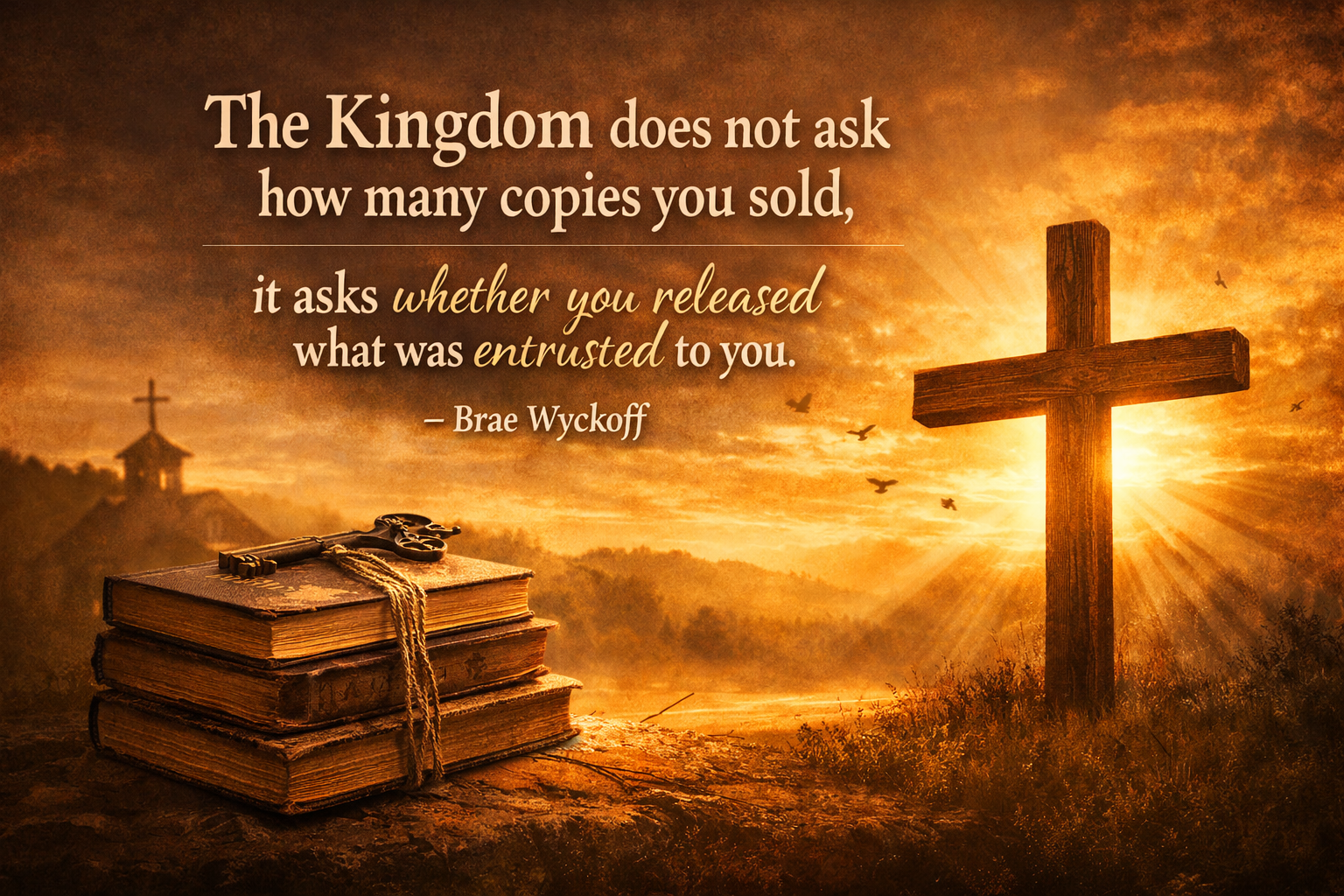
The Kingdom Economy of Creativity
The Kingdom Economy of Creativity
1 Corinthians 12:12, 27
“The body is one, made of many parts, and you are the body of Christ.”
1 Corinthians 3:6-7
“I planted, Apollos watered, but God gave the growth, so neither the one who plants nor the one who waters is anything, but only God who gives the increase.”
The world trains creatives to stare at the individual scorecard.
How many copies did my book sell?
Did my message land?
Was my work noticed?
That way of measuring feels normal because it is everywhere. It is also foreign to the Kingdom.
Let’s slow this down and look at the reality.
In the United States alone, roughly 10,000 new Christian books, excluding Bibles, are released each year. The average self published book sells about 250 copies over its lifetime. Taken together, that is roughly 2.5 million copies moving into the world from one year’s obedience.
Two and a half million.
Not from one author.
Not from one platform.
Not from one ministry.
From the body.
Scripture never presents the Kingdom as a collection of independent performers. It presents it as a living organism. Eyes do not compete with hands. Feet are not discouraged because they are not mouths. Every part contributes to circulation, not recognition.
Paul says we are many parts, but one body. That language is not poetic; it’s structural. Bodies do not function on individual achievement. They function on shared flow.
The Kingdom economy measures movement, not spotlight.
When a believer releases a book that sells fifty copies, the world whispers failure. But the Kingdom asks a different question. Did the message move? Did truth circulate? Did obedience happen?
Those fifty copies did not vanish. They entered households. They were read, skimmed, highlighted, argued with, prayed over, and handed off. They joined a larger river of words flowing from thousands of obedient hands.
One plants.
One waters.
God gives the increase.
Notice what Paul does not say. He does not say, “One plants and checks the analytics.” He does not say, “One waters and compares outcomes.” He removes ownership from results entirely.
That is deeply offensive to a marketplace mindset.
In a Kingdom framework, the grand total matters more than the individual count because the Head is Christ, not the author. When we isolate our work from the body, we unknowingly adopt a secular measurement system and then wonder why pressure follows.
Pressure is the fruit of self-centered accounting.
Peace comes when we remember that circulation is success.
A body does not ask whether a single blood cell reached enough organs. It trusts the system God designed. Our role is faithfulness in function.
Your book may be a seed.
Someone else’s may be water.
Another may be shelter for wounded faith.
None of them are wasted.
The danger is not low numbers.
The danger is measuring obedience with a ruler God never handed us.
Prayer
Lord, free us from individual striving disguised as faithfulness.
Reconnect our work to Your body, not our ego.
Teach us to rejoice in circulation, not comparison.
Let us measure success the way Heaven does, by obedience, by faithfulness, by love released into the world.
Amen.
Closing Thought
When the body moves together, even quiet obedience adds up to millions.